
What Older West Oahu Homes Are Quietly Carrying
Older Ewa and Waipahu houses tend to carry four things at once: supply lines narrowing from the inside, drains at the end of their service life, shutoff valves that will not close, and a heater sized for a smaller household than yours. You do not have to fix all four. Fix the ones that can flood the house first, then the ones that affect water you drink and bathe in, and let the cosmetic things wait.
We get called to an older West Oahu house and the homeowner apologizes for the plumbing before we have looked at anything. They should not. There is nothing wrong with an older house. What there is, reliably, is a set of parts that have been doing their job quietly for a very long time and are now near the end of it, all at roughly the same time, because they all went in on the same week.
This is a walkthrough of what we actually find, so that you know what you are looking at before somebody with a clipboard tells you.
Which era your house belongs to
West Oahu is not one housing stock. It is several stacked next to each other, and the age bracket a house falls into predicts most of what is behind its walls.
The oldest are the plantation era homes, mostly around Waipahu and the older pockets of Ewa. Single wall construction, raised off the ground on posts rather than sitting on a slab, and plumbing that has been added to and rerouted by successive owners over the decades. The upside is access. When a house sits on posts, a lot of the pipe is reachable from underneath without opening a wall, which makes both diagnosis and repair far less invasive than people expect.
Then there is the mid-century tract housing through Ewa and Waipahu. Concrete slab, galvanized steel supply lines as the common era material, cast iron for the drains. These are the houses where all four problems in this article tend to show up together, and they are the bulk of what we see.
The Kapolei and Ewa Beach tracts from the eighties and nineties are a different animal. Copper supply generally, plastic drains, and a set of failures that are about materials aging rather than materials being obsolete. Anything newer than that is usually fine on the pipe and starts having fixture and heater conversations instead.
Knowing which bracket your house lands in tells you which paragraph below matters most to you, and lets you skip the rest.
Supply lines that are closing from the inside
Galvanized steel pipe was the standard supply material for a long stretch of the last century, and there is an enormous amount of it still in the ground and in the walls out here.
It fails in a way that is easy to miss because it happens from the inside out. The zinc coating on the inside wears away, the steel underneath starts to corrode, and rust builds up as a rough layer on the pipe wall. Every year that layer thickens, and the opening water travels through gets smaller. A pipe that was three quarters of an inch when it went in can end up carrying the flow of something far narrower without any outward sign. From the outside, the pipe looks the same as it did on day one.
The tell most people notice first has nothing to do with pressure. It is coming home after a week away, opening a tap, and getting brown or rust colored water for the first ten or fifteen seconds before it clears. That is the corrosion layer shedding into water that sat still long enough to pick it up. If that happens after a vacation, or every Monday morning at the sink nobody uses on weekends, your supply lines are telling you what they are made of.
The other tell is that hot water is worse than cold. Heat accelerates the whole process, so the hot side of a galvanized system usually degrades faster and further. If your hot water runs discolored while the cold runs clear, that points at the water heater or the hot supply rather than the whole system, and it is worth having somebody look before you conclude anything.
Replacing the supply throughout a house is its own project with its own logistics, and our repiping page covers what that involves. What matters here is the diagnosis: knowing whether you have galvanized, and how far along it is.
Cast iron drains at the end of a long life
The other half of an older system is the drain side, and cast iron was the material of choice for a very long time. It was a good choice. It is quiet, it is strong, and plenty of it has outlasted the people who installed it.
What it does not do is last forever. Cast iron corrodes from the inside along the bottom of the pipe, where waste water sits longest. The interior roughens, the roughness catches solids, the catching creates more roughness. Late in that cycle the bottom of the pipe can thin out until it is barely there, which is why a camera inspection of an old cast iron line sometimes shows what looks like a trough instead of a round pipe.
You feel it before you see it. Everything in the house drains a little slowly, and not one fixture in particular. The kitchen is sluggish, the tub takes its time, a toilet gurgles when the washer empties. When a single fixture is slow you have a clog at that fixture. When the whole house is uniformly unhurried, the shared line downstream is the suspect.
The smell is the second sign, and it is the one that gets people to call. A faint sewer odor that comes and goes, usually stronger in a bathroom nobody uses much or on humid days, means gas is escaping somewhere it should not. Sometimes that is a dry trap in an unused fixture, and running water for thirty seconds fixes it permanently. Sometimes it is a crack or a failed joint in the drain itself, and no amount of running water changes anything.
The good news on drains is that they can often be handled in sections. The failing part is frequently one run under a particular part of the house rather than the entire system, and a camera tells you which is which before anybody commits to anything.
The valves that will not close when you need them
This is the one that catches people out, and it is the cheapest problem on the list to solve.
Every fixture in your house has a small shutoff. Under each sink, behind each toilet, on the cold inlet of the water heater. In older homes those are often the original parts, and original stops on an old house have two failure modes. They seize, because mineral has locked the stem in place after decades of never being turned. Or the packing dries out and the stop weeps around the stem the moment you do turn it.
Older houses also frequently have gate valves rather than the quarter turn ball valves used today. A gate valve closes by lowering a metal wedge down into the flow path, and after long enough it either will not lower or will not seal when it does. The worst version is a gate valve that turns freely, feels closed, and is not, so you take a supply line apart and get a face full of water.
Here is why it matters more than it sounds. A stop that does not close is not a problem until the day something else breaks, and on that day it is the difference between shutting off one fixture and shutting off the entire house while water runs across your floor. It is a small part, it is a short visit, and it is the single highest value thing you can do in an older home.
Go test yours this month. Close every stop in the house one at a time, then open it again. Any that are stiff, weeping, or immovable go on a list. Do not force one that will not budge, because old stops shear off at the stem and turn a small job into an emergency. Just note it and tell us which ones so we can do them together in one visit.
A heater sized for a house that had fewer people in it
Walk into a closet or a garage corner in an older West Oahu house and you will usually find a tank that has been there a while, in a space that was carved out to exactly fit it and nothing else.
The recurring issue is not age. It is capacity against how the house is actually used now. A tank chosen for the household that lived there when it went in gets asked to serve more people, longer showers, and a modern washer, and the tank has no opinion about any of that. It just runs out. The complaint we hear is that the last person in the morning gets a cold shower, and the assumption is that something is broken. Usually nothing is broken. The tank is simply doing what a tank that size does.
The closet itself is worth a look while you are there. Tight enclosures built around a tank make service awkward and can make a straight swap surprisingly involved, because the replacement has to fit through a door that was framed around the original. That is worth knowing before you are standing there on the day the old one gives up, rather than discovering it under pressure.
The wall you open and what is behind it
Renovations in older homes go one of two ways, and which one is mostly decided in the first hour.
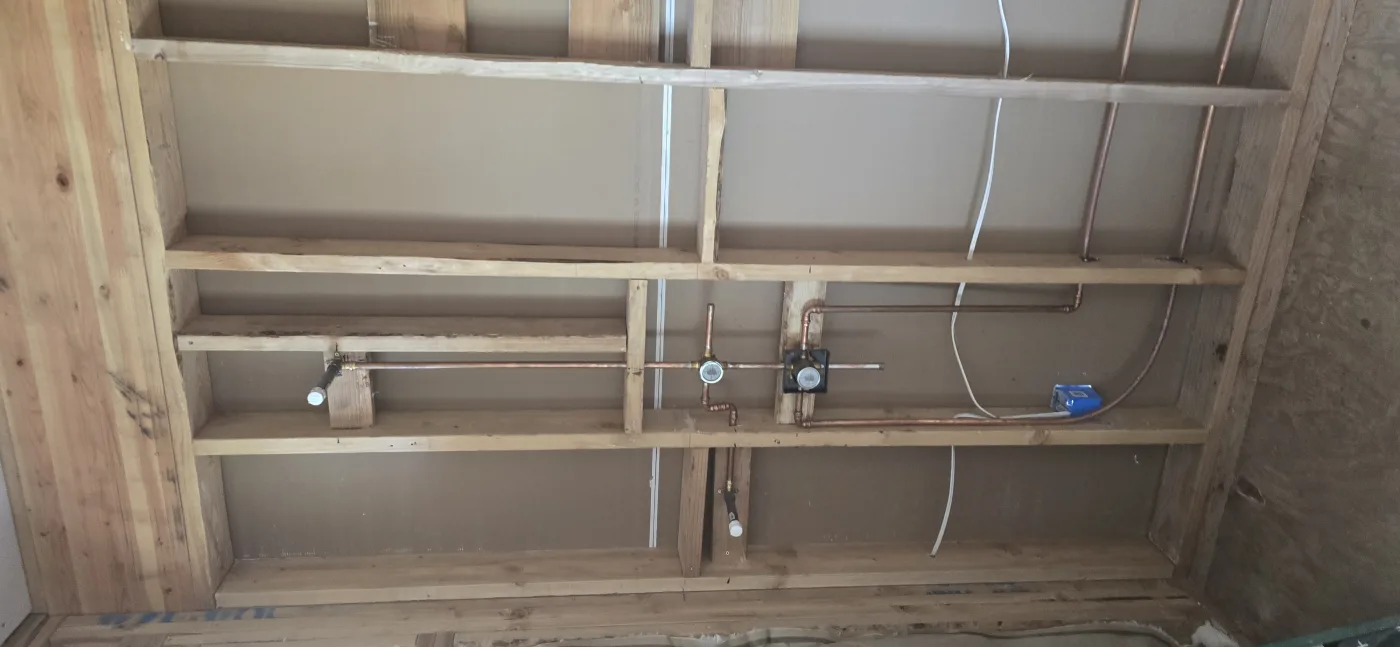
You open a bathroom wall for a shower valve and you find galvanized supply behind it. Now you have a choice nobody planned for. Connect new fixtures to old pipe and accept that you have put nice finishes in front of a system on borrowed time, or expand the scope while the wall is already open. Neither answer is wrong. What is wrong is being asked to decide in ten minutes with a demolished bathroom behind you.
So we say it before the work starts. If your house is in an era where old supply or drain material is likely, we would rather look first and tell you what is probably behind that wall, so the decision gets made on a calm afternoon rather than mid-project. Opening a wall you were opening anyway is the least expensive access you will ever get.
The other conversation worth having early is permitting. Fixture swaps and repairs are ordinary work. Once you are moving drain lines, relocating fixtures, or changing what the house is piped with, permits and inspections enter the picture, and they should. Ask any contractor how they handle that before hiring them. Anybody who waves the question away is telling you something.
Buying an older island home: get it looked at first
If you are in escrow on an older West Oahu house, a plumbing specific look is worth more than the general inspection line item that says the plumbing is functional.
Functional means water came out when the inspector turned the tap. It does not tell you what the supply is made of, how far a galvanized line has narrowed, what the drains look like from the inside, or whether the stops close. Those four answers change what you should expect to spend in your first years in the house, and knowing them before closing is very different from learning them after.
A camera down the main drain line and a real look at the supply material at a few stub-outs is a short visit. Our leak detection equipment is the same gear we use for this kind of look, because finding what is wrong without opening anything is the whole point. If it comes back clean, you bought certainty. If it does not, you have real information at the exact moment it is most useful to you.
Cannot do everything: what comes first
Almost nobody handles all of this at once, and nobody should feel like they have to. There is a defensible order.
First is anything that can flood the house. Stops that will not close, a gate valve that has given up, a heater with visible corrosion at its fittings. These are small jobs and they cap your downside on every other problem you still have.
Second is supply. It is what you drink, cook with, and bathe in, and unlike a slow drain it does not announce itself before it fails. Discolored water on the first draw is your cue to plan rather than wait.
Third is drains. Slow is annoying and a smell is unpleasant, and neither one usually causes damage on a schedule you cannot control. Camera it, know where you stand, handle sections as they need it.
Cosmetic finishes come last, always. New fixtures on old pipe is money spent on the part you can see, in front of the part that will interrupt you later. If a budget only stretches to one of the two, put it behind the wall. That is what we would do in our own house, and it is what we tell people even when the other answer would be a bigger job for us.
Questions about older West Oahu homes
How do I tell what my supply pipe is made of?
Look under a bathroom sink at the short stub-outs coming through the wall. Dull gray metal with visible threads at the fittings is galvanized steel. Brown, dull metal with soldered joints is copper. Rigid cream or tan plastic with glued joints, or flexible tubing with crimp rings, is one of the plastics. A refrigerator magnet is the quick separator: it grabs galvanized steel and ignores copper entirely.
Is brown water after a vacation actually dangerous?
It is mostly iron and it clears when you run the tap. What it is really telling you is that your supply lines are shedding material, which means they are corroding on the inside. Treat it as a signal about the pipe rather than an emergency about the water, and get the material identified so you know what timeline you are on.
Can cast iron drains be repaired instead of replaced?
Frequently, yes, and in sections. Failures usually concentrate in one run rather than throughout the house. A camera shows where the pipe is thin or cracked and where it still has years in it, so you replace the part that has failed and leave the rest alone. Anyone recommending a full replacement without putting a camera down the line first should be asked why.
My shutoff valves all look old. Do I replace them all at once?
That is usually the efficient way to do it, because the visit is the expensive part and the valves are not. Test every one first and make a list. If most of them are stiff or weeping, doing them in a single pass costs less than three separate calls over two years and leaves you with a house where every valve actually works.
Is an older Ewa or Waipahu house a bad buy because of the plumbing?
No. It is a house where you should know what you are getting rather than guess. Every item on this list is a known quantity with a known fix, and none of it is a reason to walk away from a house you want. The mistake is buying without looking, then meeting all four of these in your first year and having to handle them in whatever order they break.
Want to know what your older home is carrying?
We will identify your supply material, camera the drains, test every stop, and give you a straight list in priority order.