
Find the Ewa Beach Leak Before the Wall Opens
A bill that jumped, a warm patch on the floor, a damp baseboard. We locate it first, then repair the smallest possible piece.
Proof
“Paul quickly identified my toilet was leaking from a failed wax seal which was not visible to me. He fixed it immediately.”
Yelp review, Shoreline Plumbing customer
That is the short version of what leak work is supposed to look like. Somebody who does this every week walks in, finds the thing you could not see, and fixes it. No exploratory demolition, no long list of maybes, no charging you to look twice.
Meter
Your bill noticed before you did.
Most of the hidden leaks we find in Ewa Beach get reported the same way. The bill came and it was double, or close to it, and nothing in the house changed. No new people, no new landscaping, nobody filling a pool. Water is going somewhere, and the meter is the only thing that saw it.
Most of the hidden leaks we find in Ewa Beach get reported the same way.
You can confirm it yourself in about twenty minutes. Turn off every tap, the washer, the dishwasher and the ice maker, then go out to the meter box at the front of the property and note where the dial sits. Come back in fifteen minutes. If it has moved, water left the system while nothing in the house was using any. Some meters have a small triangular or star-shaped indicator that spins on the tiniest flow, and if that is turning you have your answer immediately.
What the meter cannot tell you is where. That is the part worth paying for, and it is the part that decides how much of your house has to be opened up. A leak that gets located precisely is a small repair. A leak somebody goes looking for with a saw is a different afternoon entirely.
Slab
Listening our way to a spot on the floor.
A supply line running under a concrete slab that starts leaking gives you almost nothing to look at. Sometimes a warm patch underfoot on a hot-water line, sometimes a hairline crack, often just the bill.
We isolate and pressurize the line, then work across the floor with acoustic equipment that hears water escaping through concrete. The sound is loudest directly over the break. Comparing readings as we move narrows it from a room to a small area, and that area is what gets opened.
- A warm spot on the floor with no obvious cause
- The sound of running water with every tap closed
- A hairline crack that has appeared in the slab or tile
- Floor covering lifting or a damp edge at the baseboard
- Hot water that never quite runs out at the tap
- A meter that keeps moving with the house shut down
Walls
Damp baseboard, higher problem.
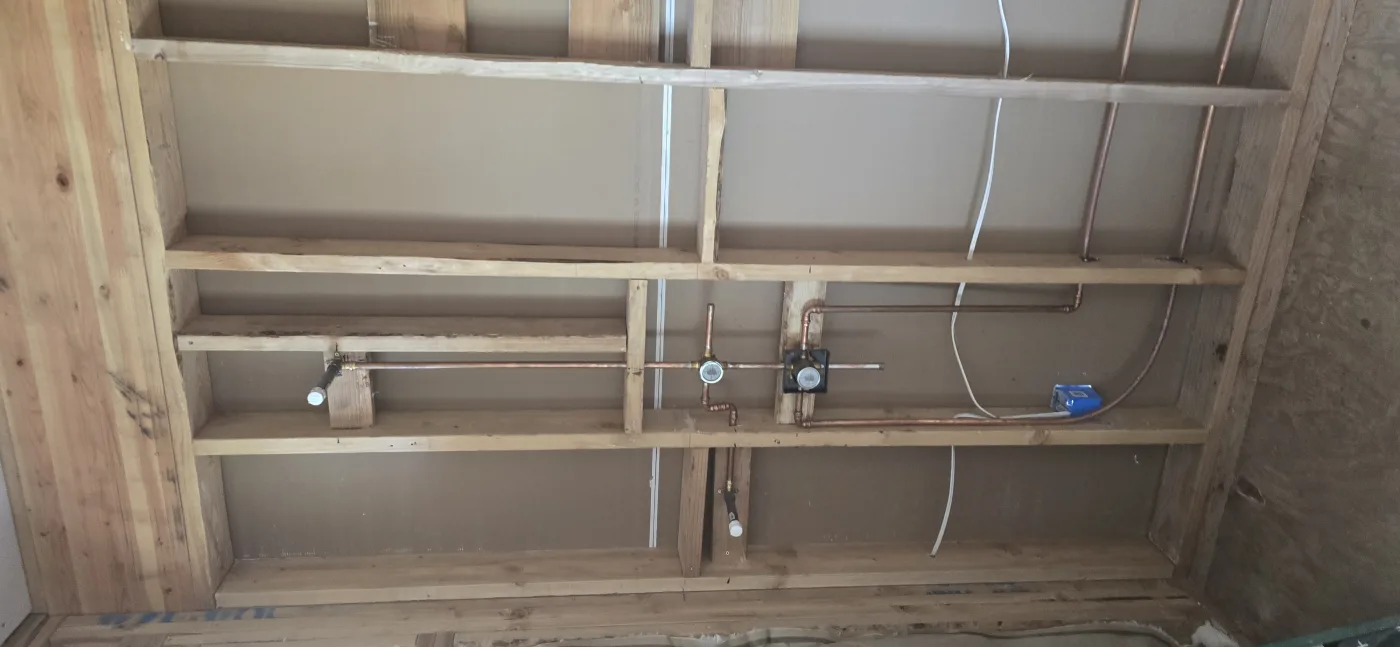
When drywall is wet along the bottom of a wall, the instinct is to cut there. That is usually the wrong spot. Water leaving a pipe inside a wall cavity runs down the face of the framing and pools at the base plate, so the visible damage sits well below the failure. Open the wall at the wet patch and you find soaked insulation and no leak.
We trace moisture upward through the cavity first, then confirm with pressure on the line before anyone picks up a saw. In condo and multi-unit buildings that matters even more, because the pipe causing your damp wall may be serving a neighbor, and the repair has to start with knowing which line and which unit.
Getting this right is the difference between one tidy patch and three holes in a hallway. It is also the difference between a repair you can plan and one that keeps growing while everyone guesses.
Copper
Pinholes and what the salt air does.
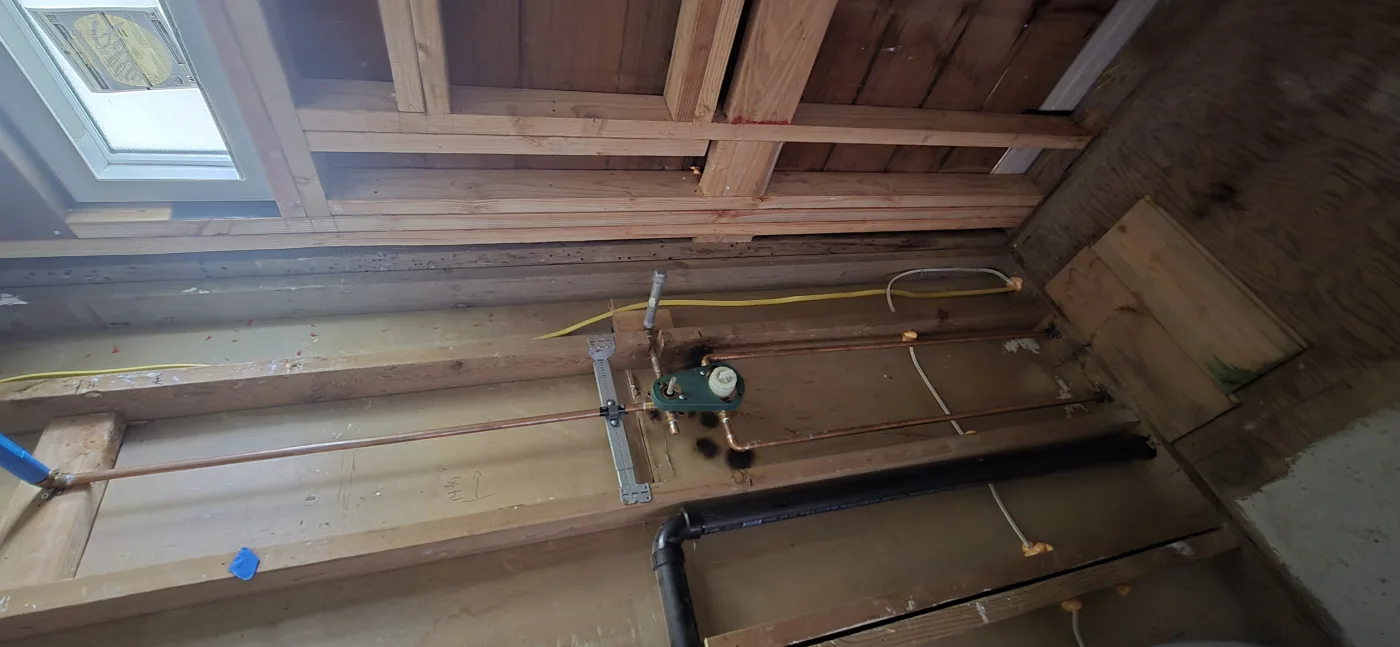
Living near the water costs you something on the plumbing side. Salt air works on copper from the outside, and it goes after exposed runs, hose bibs, and fittings near an exterior wall first. Meanwhile water chemistry works on the inside of the same pipe. Where those two meet you get a pinhole, a hole small enough to weep quietly into a wall or a cabinet for months before anyone notices.
One pinhole is a repair. We cut the bad section, put in new, and you move on. Two or three in the same house within a year is the pipe telling you its whole run is at the same age and in the same condition, and at that point patching leak by leak stops being the cheaper path.
We will say which situation you are in rather than quietly repairing the same house four times. If it is time to talk about repiping, we will tell you, and if it is not, we will tell you that too.
Report
What you hold at the end of the visit.
When the plumber packs up you should know four things: where the leak is, what failed, what the repair involves, and what it will cost. Not a range, not a guess, a number you agreed to before work started. That number is what you pay when it is done.
If an insurance claim is in play, that documentation matters as much as the fix. Knowing the location and cause before anything gets opened keeps the claim clean and the repair contained. We are happy to walk you through it in plain words, not plumbing vocabulary.
Ready to get it looked at? Send us the details or call the crew at (808) 445-3585. Other work close by: Drain Cleaning · Emergency Plumbing · Water Heater Installation. There is more about our island-wide leak detection, the rest of what we do in Ewa Beach, and recent jobs from around Oahu.
Answers
Frequently asked questions
My bill doubled and I cannot see any water. Is that really a leak?
Usually, yes. Shut every fixture off, then watch the meter for fifteen minutes. If the dial keeps creeping, water is leaving the system somewhere you cannot see. That is a hidden leak, and the two most common places for one are under a slab and inside a wall.
How do you find a slab leak without tearing up the floor?
We pressurize the line and listen with acoustic equipment that picks up the sound of water escaping through concrete. Moving across the floor and comparing what we hear narrows the spot down to a small area. The opening we make is sized to that area rather than a guess across the room.
Why is the drywall wet at the bottom of the wall only?
Water inside a wall runs down the framing and collects at the base plate, so the damage shows up well below where the pipe actually failed. That is why we trace moisture up the cavity before opening anything. Cutting at the wet spot often lands a foot or more from the leak.
Does salt air really put pinholes in copper?
Salt air attacks copper from the outside, especially on exposed runs, hose bibs and fittings near an exterior wall. Add water chemistry working on the inside and you get pinholes, small enough to weep for months. One is a repair. Several in one house is usually a conversation about repiping.
What do I get at the end of the visit?
You get the location of the leak, what kind of pipe failed and why, what the repair involves, and the price before any work starts. If you need something for an insurance claim, you have that too. The quote we give is the number you pay.
Should I just wait and see if it gets worse?
A leak under pressure never gets better on its own, and the bill is only part of the cost. Water running into a slab or a wall cavity for months does damage that outlasts the repair. Finding it early keeps the opening small, which is the whole point of detecting before digging.
Schedule
Send us the leak
Tell us what you are seeing, what the bill did, and how long it has been going on. We will reach out to set up a visit in Ewa Beach. Or call John’s crew at (808) 445-3585, we answer.