
Reaching an Old Shower Valve, and the Shutoff That Sticks
When a closet or bedroom backs onto your shower, we usually reach the valve from that side and leave a removable panel for next time. The other half of the job is getting the water to stop, and in older homes the main valve and the little stops are often the hardest part of the day.
Two practical questions decide how a shower valve job goes. How do we get to the valve, and will the water actually shut off when we ask it to?
Whether the repair itself is a new cartridge or a whole new valve body depends on what shape the valve is in, and an earlier post on this blog about a Kailua shower walks through telling those apart. The full job, symptoms through trim, is on our page for shower valve replacement in Kaneohe. This post covers what surrounds the repair.
Look at the far side of the shower wall
Before anyone touches the shower, walk around to the other side of that wall and see what is there. A linen closet, a bedroom closet, a hallway, a bedroom with a dresser pushed against it, the outside of the house, or the tile of another bathroom. That answer decides how we reach the valve.
If it is a closet, look low on the wall for a small square cover roughly opposite where the shower handle sits. Some builders left one, and plenty of homeowners have never noticed it behind shoes and storage bins. If you find one, send us a photo before the visit.
If there is no cover, look at what hangs on that wall. Built-in shelving, a mirror, wallpaper or a closet rod each change the plan a little. Clearing the closet floor and the lower shelves before we arrive helps more than anything else you can do ahead of time.
Going in from the closet or the room
From the back side, the opening goes between two studs, sized so hands and tools have room around the valve body. We lay drop cloths, keep the dust inside the closet as much as we can, and do the work without touching the finished face of the shower at all.
A bedroom wall works the same way, with more care for furniture and flooring. We move what needs moving, or ask you to clear the area the day before. Drywall cuts cleanly and repairs easily, which is the whole reason the back side beats the tile side whenever the house offers it.
When there is no back side to use, such as an outside wall or a second tiled room, the work has to come through the shower itself. Keeping that opening small is a subject of its own, and the replacement page linked above covers how we do it.
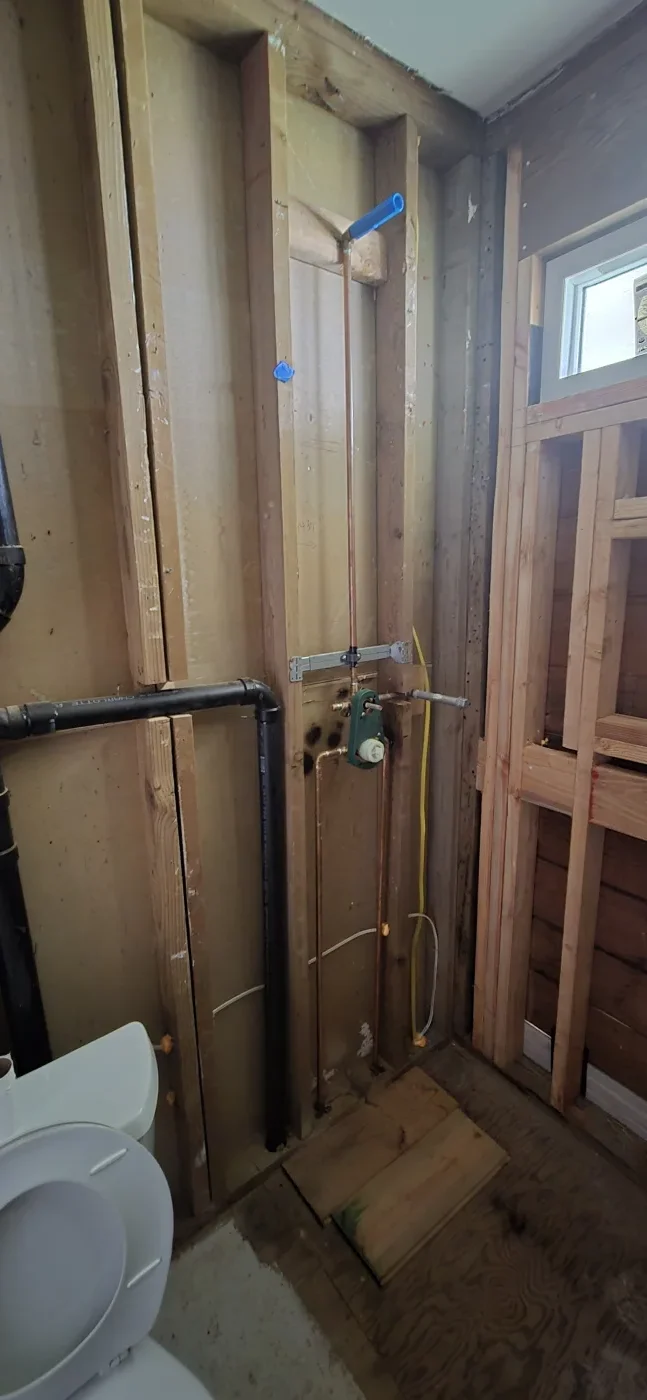
The panel we leave for next time
After the valve is done and tested, the closet opening does not have to become a drywall patch. We frame it and close it with a removable cover, held by screws or clips, so the back of the valve stays one step away from whoever needs it next.
That cover earns its keep later. The next cartridge change, a check for a slow leak, or closing a stop inside the valve all go faster when someone can see the back of the body. Nobody has to cut into the wall again just to find out what is happening behind it.
A couple of requests once it is in. Do not paint or caulk the cover shut, and do not park a heavy cabinet in front of it. Painted to match, it disappears into the closet anyway. When you sell, tell the next owner where it is.
When the main shutoff will not close
Many showers have no working shutoff of their own, so the water to the house goes off for the repair. That is where an older home can stall the job before it starts. The main valve may not have been turned in a very long time, and humid windward air is unkind to brass and steel that never move.
We test it first thing, before the shower trim even comes off. Sometimes the handle turns and water keeps flowing anyway. Sometimes it will not budge at all, and putting real force on a seized valve is how a stem snaps and an ordinary morning becomes a flood. We do not force it.
If the main will not hold, we stop and talk it over with you. Replacing it can usually happen during the same visit, though the water then has to be shut off farther upstream, which changes the order of the day. Settling that calmly at the start beats discovering it with the old valve already cut out.
Seized stops, at the shower and under the sinks
Some shower valves have small stops on the hot and cold inlets, set behind the trim so a plumber can isolate just that shower. On older valves those stops are often frozen with mineral buildup, and turning one can start a drip at its own stem. We work them gently, and if one weeps, it gets replaced along with the cartridge or the body.
The stops under your sinks and behind your toilets are usually in the same shape. With the house water already off for the shower, swapping the worst of them for new quarter-turn stops adds little time, and every future repair in the house can then be handled one fixture at a time. If the bathroom is being gutted anyway, shower valve installation in Kaneohe is the better fit, and our shower valve replacement overview covers this work across Oahu.
Plan on the water being off for part of the visit, and fill a few pitchers beforehand for coffee or flushing. We tell you before it goes off and again when it comes back on. Photos of finished jobs are in our gallery.
Valve access and shutoff questions
Should I test my main shutoff before you come?
Find it and look at it, yes. Turning it is a judgment call. If it moves easily and closes, open it back up and tell us it works. If it feels stuck, leave it alone rather than putting a wrench on it. A broken stem the night before the visit is not the head start anyone wants.
Can the access panel go somewhere less visible?
It has to sit behind the valve to be useful, but inside a closet that usually means low and out of sight. In a bedroom we can often line it up behind furniture that moves, or finish it so it blends with the wall. We talk placement through with you before anything gets cut.
What if the closet behind my shower has built-in shelves?
We look at how they are attached first. Often a lower shelf or a back panel can come out and go back in without trouble. If the built-in cannot move without damage, we compare that route with going in from the shower side and tell you plainly which leaves less to put back.
A failing valve is ordinary work. What makes the day go smoothly is knowing ahead of time what sits behind the wall, and whether the water will really shut off.
Old valve, stubborn shutoff?
Send a photo of the closet or room behind the shower and one of your main valve. That tells us how we will get in and how the day will go.