
When a Tankless Water Heater Keeps Faulting or Running Cold
Keep a short record of each fault: the time, which taps were open, the exact code on the display, and anything that changed around the house lately. A few lines like that usually point us toward the cause before we arrive, and they make the first visit shorter.
An intermittent fault is the hardest kind to chase, because the heater is usually behaving perfectly by the time anyone shows up to look at it. The best tool for catching one is a notepad by the door, or the notes app on your phone.
What you write down between faults is often worth more than anything a plumber can see in a single visit. A week of notes shows a pattern, and a quiet heater on a sunny afternoon shows nothing at all.
Write down when it happens
Start with the clock. Does it fault on the first shower of the morning, or only after several people have used hot water back to back? In the middle of the day, when one person runs a tap, or in the evening when dinner, dishes and baths all overlap? Write the time down every time, even when it seems random.
Timing narrows the field fast. A heater that only quits after a long stretch of hot water is behaving differently from one that quits the instant a tap opens. One that trips at the same hour every evening points toward something else running in the house at that hour. A fault that first appeared the morning after the power blinked tells its own story.
If it happens while nobody is watching, note when you found it, what the display showed, whether every tap was cold, and whether the unit came back after you closed the tap and opened it again.
Write down which taps were open
Next, note where the water was going. One shower by itself? A shower and the washing machine together? The kitchen sink while someone filled the tub? If the fault only ever shows up at one fixture, say so, because that changes where we start looking.
Flow is the reason it matters. A tankless unit lights when enough water moves through it and shuts down when the flow sinks too low. A single bathroom with a water-saving showerhead, a handle set barely past warm, or a clogged aerator can sit right on that edge. Two or three fixtures at once can push the burner to its limit from the opposite direction.
Tell us too if hot water arrives fine in one bathroom and fails in another. A heater that only misbehaves for the far shower, or only for the newly remodeled one, is handing us a strong clue.
Copy the code exactly, and photograph the label
When a code appears, write it exactly as shown, letters and numbers both, and keep a tally of how often it comes up. A photo of the display is better still. Codes that look alike can mean very different things from one brand to the next, so close is not good enough.
Then photograph the rating label on the side of the unit. It carries the make, model and serial number. With those we can look up what that code means for your particular heater, check whether parts are still made for it, and bring the likely ones on the first trip. Some units also keep a short list of recent codes in their menu, and if yours does, a photo of that screen helps as well.
Try not to keep clearing the fault and hoping. On some models repeated resets wipe the stored record, and the cause stays right where it was.
Write down what changed around the house
Most new faults have a recent cause, and homeowners often know it without realizing. Think back over the past few weeks. Did someone put in a new showerhead or faucet? Did a remodel start or finish? Was a gas dryer, range or grill added to the same line? Did anyone work on the gas, or shut the water off to the house?
Changes outdoors count too. A sprinkler that got moved and now soaks the cabinet. Plantings that have grown up around the vent. A power outage. Street work that left the water cloudy for a day, since grit stirred up in the lines can reach the heater’s inlet screen and choke the flow in a hurry.
Even small changes deserve a line. We would rather hear about a new showerhead that turns out not to matter than miss the one detail that explains everything.
How your notes turn into a first visit
Patterns point at causes. If the faults line up with the dryer running, the gas supply is the first suspect. If they only happen at one water-saving shower, flow is. A string of overheat codes on a unit nobody has ever flushed leans toward scale. Your notes let us arrive with a working theory instead of a blank page.
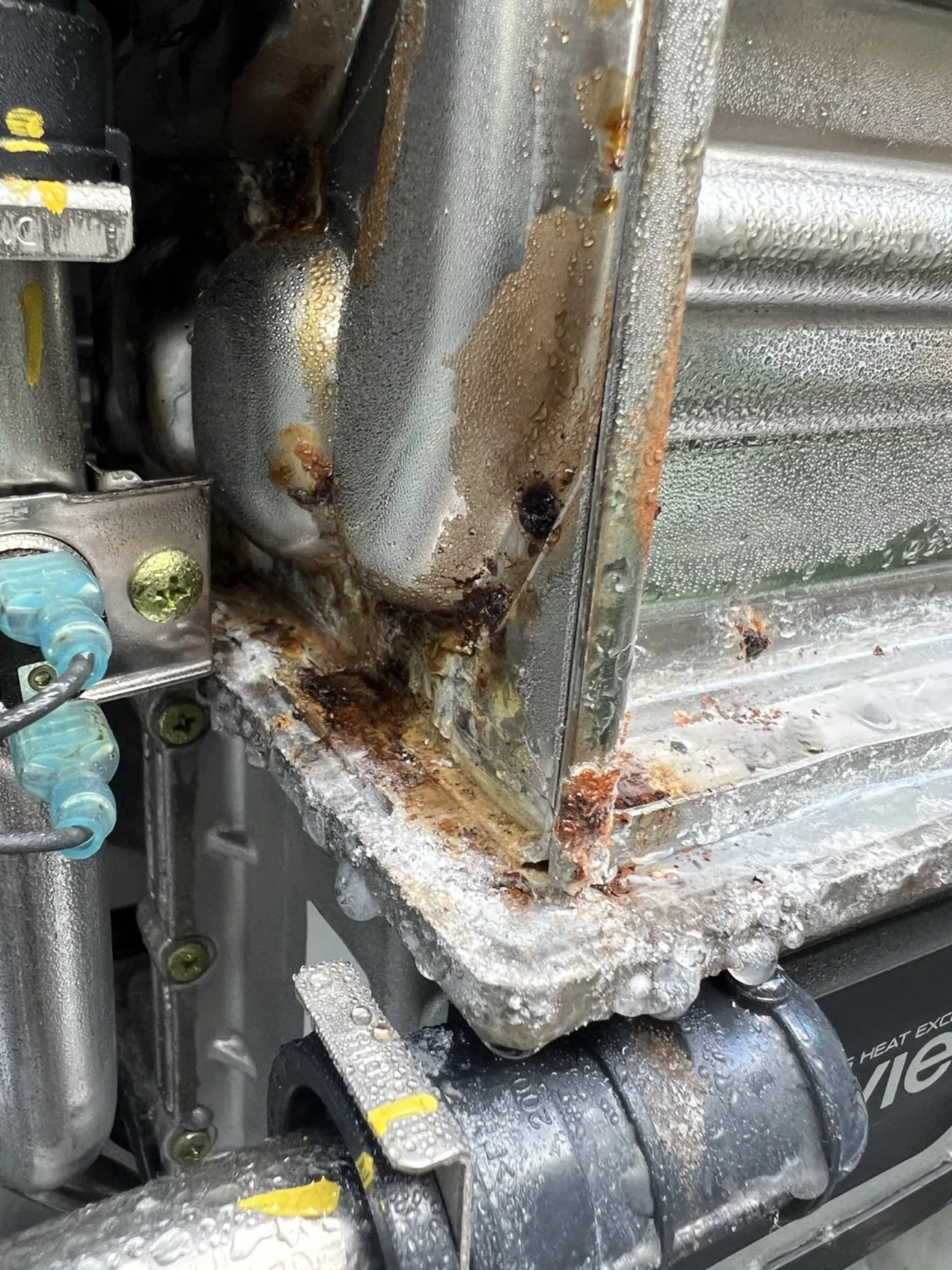
On the visit we start by reading what you wrote. Then we try to make the fault happen on purpose: open the same taps, run the same appliances, and watch the unit while it happens. We pull up any stored codes and look over the cabinet for water or rust. Only after that do we talk about repairs, and you get a price before any part goes in.
The likely causes themselves, from scale to ignition trouble, are laid out on our page for tankless water heater repair in Kaneohe, and the tankless repair overview covers the same work across Oahu. If the answer turns out to be a new unit, tankless installation for Kaneohe homes is where that starts, and our gallery shows water heater jobs from around the island.
Tankless trouble questions
Should I keep resetting the heater when it faults?
Once or twice to get hot water back is fine, but write the code down first every time. A unit that needs constant resetting is telling you something, and clearing it over and over only hides the pattern. If it faults again the same day, stop resetting and give us a call.
Is it safe to keep using it while it faults?
Most faults are the unit protecting itself by shutting down, which is exactly what it should do. If you smell gas, see water pooling underneath, or notice scorch marks near the cabinet, close the gas valve to the heater, turn off its power and call (808) 445-3585 right away.
What if it only faults once every few weeks?
Those are the hardest to catch, which is exactly why the notes matter. Keep logging each one, even when they are far apart. Once you have three or four, send them over with your photos. A rare fault with a clear pattern is much easier to fix than one described from memory.
A faulting heater is rarely a mystery once someone can see the whole pattern. Keep the notes, take the photos, and bring us in with the evidence already in hand.
Heater still throwing codes?
Send us your notes, a photo of the display and one of the rating label. With those in hand we can usually tell what to bring on the first trip.