
Where a Tankless Water Heater Goes Decides Half the Job
We pick the spot on foot. Starting at the old tank, we walk to each outside wall that could take the heater and look at what sits near it, what has to reach it, and how far hot water would travel from it. You see the tradeoffs wall by wall and make the call.
Nobody should choose a tankless location from a catalog photo. The right spot depends on the house you live in, and the quickest way to find it is to walk that house together, with the old tank as the starting line.
That walk usually turns up two or three possible walls. Each one has something going for it and something working against it, and a homeowner who has stood at all of them makes a better decision than one who simply gets told.
First stop: the old tank
We start where the hot water starts now. Standing at the tank, we note where the cold line comes in, where the hot line leaves, and how gas or power reaches it. We look at the floor under it and the wall behind it, because a tank that has wept for years leaves stains and soft spots a new heater should not inherit.
Then we ask what living with it is like. Which shower takes longest to run warm? Does anyone stand at the kitchen sink waiting? Has the tank ever run out on a busy morning? Those answers tell us which bathroom is the far one, and that far bathroom ends up shaping where the new unit should hang.
Sometimes the old spot is the right spot. When the tank already sits against an outside wall with gas close by, the walk may end right there. More often the tank was tucked wherever the builder had room decades ago, and we keep going.
Out to the walls that could hold it
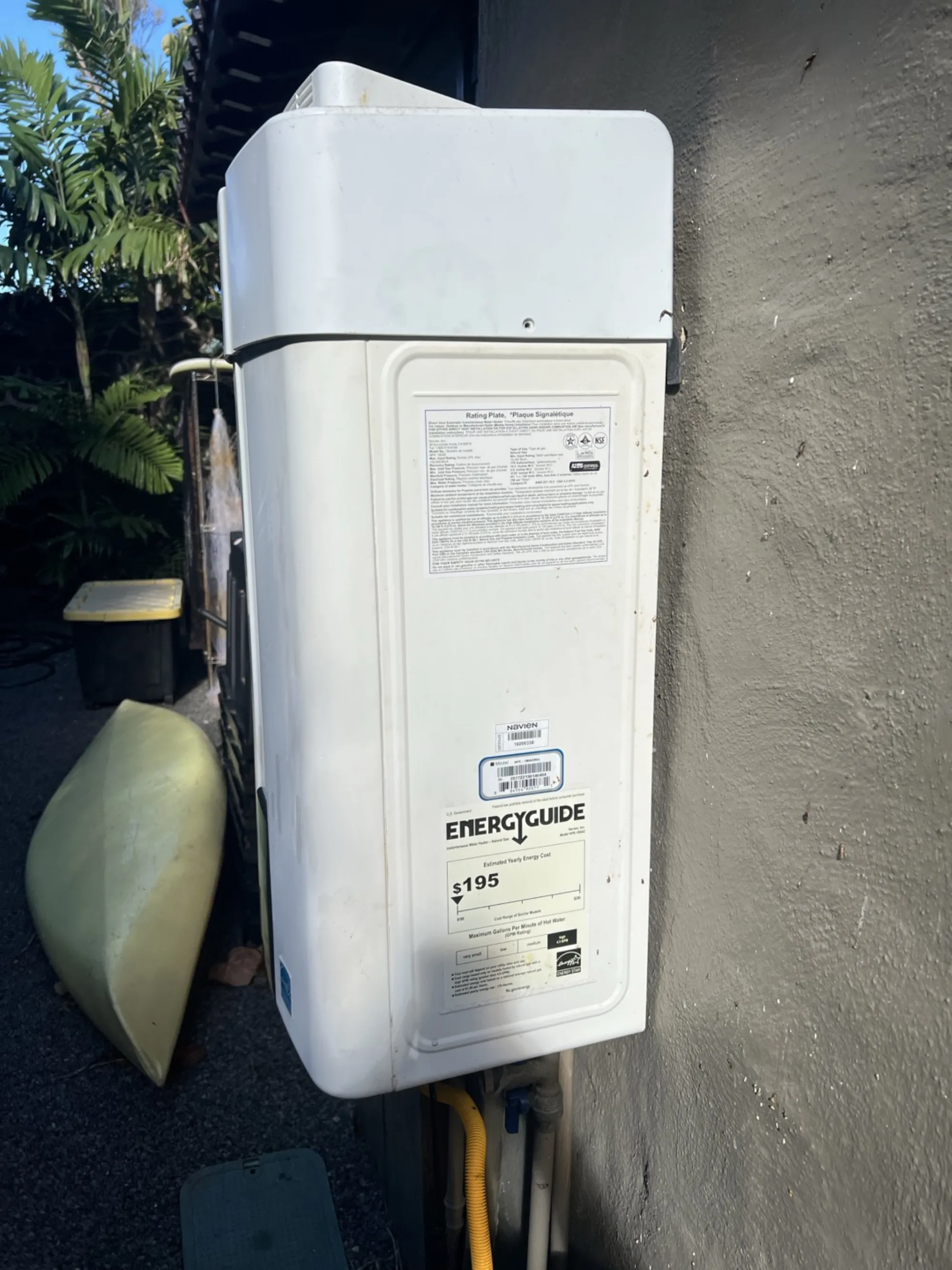
Next we head outside and stand at each wall that might work. An outdoor unit vents straight out of its cabinet, so the first thing we check is what that exhaust would sit beside. Windows that open, a door, a dryer vent, a bath fan outlet: each one sets a distance the heater has to keep, and we measure from them with a tape instead of judging by eye.
We look at what is under and around the spot. A hose bib, a sprinkler head aimed at the wall, a planter bed that never dries out, a path people walk every day. Windward plantings grow fast, and a hedge with plenty of room today can be rubbing the cabinet before long.
Then we picture someone working on it. There has to be space to stand in front of the cabinet, open the cover and hook a pump to the valves underneath. A spot squeezed behind a fence gate or a trash can corner fails that test even when every vent distance checks out.
Tracing the gas path and the long hot run
With a candidate wall in mind, we trace how gas would get there. Sometimes the existing line passes close by and only needs a larger branch. Sometimes it means running new pipe along the outside of the house or underneath it, and that work becomes part of what choosing that wall costs. We walk you along the route so the number makes sense when you see it.
The water side matters just as much. Hot water leaves the heater and travels through the house to every tap, and the farther the far bathroom sits from the wall, the longer that shower waits to warm up. Going tankless does nothing to shorten that wait. Hang the unit at the opposite end of the house from the main bathroom and somebody will feel it every single morning.
So at each wall we point down the length of the house and talk through where the hot line would run and which taps would end up closest to the heater.
How the homeowner makes the call
By the end of the walk there are usually two real choices. One wall might be nearest the gas and the far bathroom but face the street. Another might be tucked into a side yard but put the hot water on a longer trip. We lay those differences out side by side and let you weigh them.
Homeowners weigh things we cannot. Some care most about how the front of the house looks. Some do not want a fan humming outside a bedroom window, or a cabinet next to the lanai where the family eats dinner. Others want the garage floor back and will accept a longer pipe run to get it. Every one of those is a fair reason to pick a wall.
We say what each spot means for the plumbing and the price, and then the choice belongs to you. If one wall truly cannot work, you hear why right there, while we are both standing in front of it.
What you have when the walk is over
You finish with a wall picked and marked, and a plain list of what that spot needs: gas work, any new opening through the wall for the lines, an outlet if the unit needs power, and how the old tank comes out. The quote is built from that list, and the number does not grow after the work begins.
The rest of the planning lives elsewhere. Gas or electric, sizing by the showers that run at the same time, and the valves we fit for future flushing are covered on our page for tankless water heater installation in Kaneohe, and the island-wide tankless installation page explains the job anywhere on Oahu.
If an existing tankless is giving you trouble, start with tankless repair for Kaneohe homes instead. Finished installs from other houses are in our gallery.
Tankless placement questions
Do I need to be home for the walk-through?
Yes, if you can manage it. The location is your decision, and it is far easier to make while standing at each wall than from a description over the phone. If someone else in the house has strong feelings about the yard or the garage, bring them along too. It saves a second visit.
Can the heater go on the front of the house?
It can, as long as the vent distances and the gas route work there. Some homeowners do not mind the look, and a front wall is sometimes the one nearest the far bathroom. Others would rather keep it around the side where nobody sees it. We show you both options and you decide.
What if none of the outside walls work?
Then we look indoors, at a garage or a utility closet, where the unit needs its own vent run out of the house and open space around the cabinet. If neither works either, we say so plainly and talk through whether a new tank heater is the better fit for your house.
Placement is a decision you make once and live with daily. Walk the walls with us, look at each spot honestly, and choose the one that fits how your household actually runs.
Picking a spot for a tankless?
Send a photo of the old tank and the outside wall nearest to it, and tell us which bathroom waits longest for hot water.