
Pearl City’s original water lines, replaced before the next leak.
A lot of houses here have been lived in for decades on the pipe they were built with. When patching one leak at a time stops making sense, we run new lines, close the walls and keep your water on at night.
Decades
The pipe in these walls has been there as long as the family.
Pearl City is a settled place. Through the residential neighborhoods and up toward Pearl City Heights, plenty of homes have had the same owners for decades, and a good share of them still run on their original water lines. That pipe has done honest work for a long time. It is also reaching the age when plumbing needs attention, and it usually says so in small ways before it says so in a big one.
Old pipe rarely quits all at once. It gives out a little at a time, somewhere new each time.
What that looks like depends on what is behind the drywall. Galvanized steel rusts from the inside and narrows year by year, so pressure fades slowly and the first glass of water in the morning can come out tinted. Copper that has carried water for decades wears thin, often on the hot side first, and starts to pinhole. Neither one is a reason to panic. The house still works. It just means the next few years of your plumbing are worth a real look now, while you get to choose the timing.
John started Shoreline because the company he worked for did not do the work right, and he wanted people to get the service they were promised. On an older house that means looking before talking, and telling you straight what the pipe is doing, even when the answer is “not much yet.”
Tipping point
A third leak in twelve months changes the math.
One leak is a repair. We find it, fix it, test it and leave. When we are back a few months later at a different joint on the same run, and then again, each fix still holds, but you are paying over and over for pipe that is wearing out everywhere at once. These are the signs we look for together:
- Leaks that show up in a new room each time instead of at one fitting
- Pressure that has slipped for a couple of years with no clear cause
- Rust-colored water from more than one tap after the lines sit overnight
- Crusty green or white buildup on pipe you can see under the sinks
- A stain on a wall or ceiling that dries, then returns in the same spot
What we rule out before the word repipe comes up
A worn pressure regulator, a clogged aerator or one bad shutoff can make a healthy system act tired. So we check pressure at more than one fixture, run hot and cold on their own, and look at every length of pipe we can reach. If a wall is wet and nobody knows why, we find the source with detection tools before anything gets opened.
Plenty of these visits end with a new valve and nothing more. When the pipe itself is the problem, you get what we found and a clear price in plain words, and the quote is the price. Tell us what your pipes have been doing and we will come see for ourselves.
PEX or copper, picked for the house we are standing in.
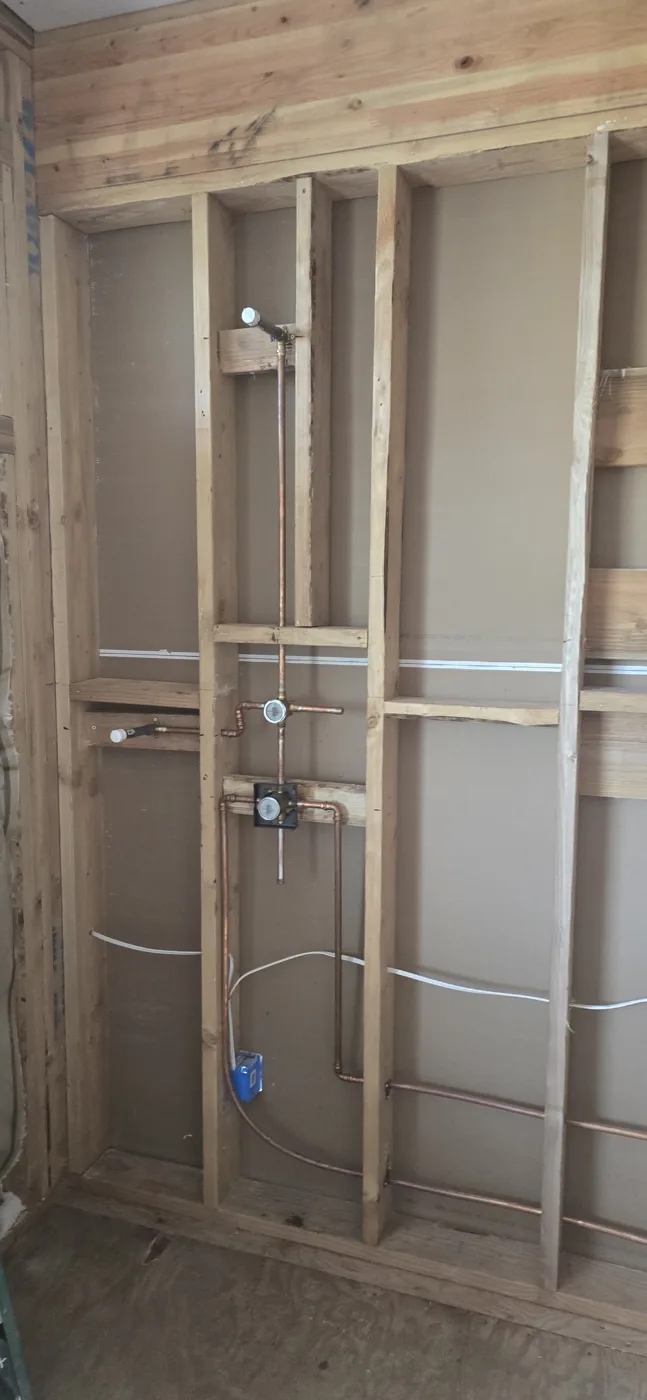
There is no one right material for every home, so we do not walk in with a favorite. PEX is flexible tubing that pulls through framing in long lengths. It needs far fewer joints, which means fewer places for a future leak and fewer openings to get it where it needs to go. It does not corrode, and it does best tucked inside walls, floors and ceilings, away from sunlight.
Copper is rigid and lasts a long time when it is sized and strapped right. Some owners simply want it, and some houses have long straight runs where it goes in cleanly. The deciding questions are practical: how the framing is laid out, how far the lines travel from the meter to the farthest bathroom, how much drywall each option means cutting, and what you would rather live with. We walk you through it and you choose. Either way it is installed by a licensed plumber and done to code.
Start my fix“All of their plumbers are highly skilled. Thank you John for always taking care of us.”

Every line in the house, or only the runs that keep failing.
Pipe does not always wear out evenly. One bathroom might have been patched twice while the kitchen side has given no trouble. The hot lines can be pinholing while the cold lines still look fine. In cases like those, a partial repipe of the worst runs is a sensible, smaller job, and we will say so.
It is the wrong call when the pipe we would tie into is in the same shape as the pipe coming out. Then a partial job just schedules the next one, and you pay to open walls twice. We cut a short section or look at an exposed stretch where we can, and we base the recommendation on what that pipe actually looks like. You get both options with a price for each, and the decision is yours.
How a repipe day runs, from the shutoff to water back on.
Morning. We protect floors and furniture near the work, then close the main or the section valve. You will know before we start which sinks, tubs and toilets are out for the day, and every opening goes exactly where we marked it with you on the walk-through.
Midday. Old lines come out or get abandoned in place, and new lines go in from the supply toward each fixture. The rest of the house keeps its water whenever the layout allows it.
Afternoon. New lines get tied in, and the section is pressure tested while the openings are still exposed. A weak joint shows itself right there, where we can reach it, instead of later behind a finished wall.
Evening. Water goes back on before we pack up, so dinner, dishes and showers happen like normal. We clean up our work area every night.
Once every section is done and tested, we patch the openings smooth and ready for texture and paint. On the final visit we run each faucet and flush each toilet with you, and show you where the new shutoffs are. If a patch or fitting is not right after we leave, call and we come back and make it right. You can see finished work from around the island in our gallery of recent jobs.
Where a Pearl City repipe conversation usually starts.
Most repipes here begin as a smaller call. A water bill creeping up with nothing visibly wet goes to leak detection first, so the source is found with tools before any wall is opened. A line that has already let go is a job for emergency plumbing.
Slow drains in older lines are handled through drain cleaning, and a water heater past the ten-year mark that has started running lukewarm belongs with water heater installation in Pearl City. Plenty of owners take care of the heater and the pipe in the same season.
Pearl City is close to home for us, so a first look at your pipes is easy to set up. More about our work around town is on the Pearl City page, and the repiping service page covers how we handle repipes across Oahu.
Not sure which of these fits your house? A rough description is plenty: what you noticed, where, and for how long. Send us the leak or call (808) 445-3585.
Repiping questions Pearl City owners bring to us
Do we have to move out while the house gets new pipe?
No. We work through the house one section at a time, so only that section is without water while its new lines get tied in. Before we leave each evening the water is back on, and the kitchen, bathrooms and laundry work as usual overnight.
Our house is still on its original pipe but nothing is leaking. Should we repipe anyway?
Not automatically. Old pipe that holds pressure and gives clean water can have years left in it. We can look at what you have, check pressure at a few fixtures and tell you plainly whether it is time or whether it is something to keep an eye on.
How do you decide between PEX and copper for our house?
We look at how the framing is laid out, how far the runs go, how much wall or ceiling each material would mean opening, and what you would rather have. PEX needs fewer joints and fewer openings. Copper is rigid and lasts when it is supported right. We lay out the tradeoff and you make the call.
Can you replace just the worst lines and leave the rest?
Yes, when the pipe the new section ties into is still in good shape. If that pipe is as worn as what we would be pulling out, we tell you before any work starts, so you are not paying to open the same walls a second time.
Who closes up the openings in the walls afterward?
We do. Every opening is marked with you before any cutting and kept as small as the job allows. After the new lines pass a pressure test we patch them ourselves and leave them smooth and ready for texture and paint.
Does a repipe need a permit, and who takes care of it?
A repipe is permitted work, and pulling that permit is on us. Shoreline Plumbing holds Hawaii license #37423, and a licensed plumber runs every new line to code.
Your pipes
Tell us how the water has been acting.
Roughly how old is the house, has the pressure changed, and where have leaks turned up so far? We will set up a visit from that, or you can call the crew at (808) 445-3585.