
Kaneohe Tankless Heaters, Back to Steady and Hot
Shower going hot, then cold, then hot again? A code blinking on the front panel? Here is what we look for, what you can safely check first, and when a repair stops making sense.
Hot, then cold, then hot again.
Most tankless owners meet this one eventually. You shut the shower off for a minute, turn it back on, and get a few seconds of hot, then a slug of cold, then hot again. Plumbers call it a cold water sandwich. The hot water sitting in the pipe arrives first, the heater needs a moment to sense flow and light, and the cold that slipped past during that pause shows up before the freshly heated water does.
A little of that is normal. A lot of it is a symptom.
When the swing runs long, or it happens in the middle of a shower that never shut off, something else is going on. The usual suspects are flow dropping below what the unit needs to stay lit, a clogged inlet screen, scale on the heat exchanger, or a flow sensor on its way out. Sometimes the heater is fine and the trouble is a worn single-handle valve elsewhere in the house letting cold water cross into the hot line. When that is the culprit, replacing the shower valve fixes it, and no part inside the heater will.
We test before we touch anything, because guessing gets expensive fast. Our island-wide page on tankless water heater repair goes deeper on the individual parts.
Checks
Three things worth checking before you call.
When the display shows an error code, write it down, and snap a photo if you can. It points us to the right part before we head over. Then go through these, and stop there.
- Power. Outdoor units still need electricity for the fan, the controls and the igniter. Check the breaker, and if the unit plugs in, check that outlet too.
- Gas. The valve on the gas line near the heater should have its handle running in line with the pipe. If the stove and other gas appliances are out as well, the problem sits upstream of the heater.
- Inlet screen. A small filter sits where cold water enters the unit. Close the cold isolation valve, unscrew the screen, rinse out the grit and put it back. Your owner’s manual shows where it lives.
Leave the cover on. There is line voltage and a gas burner inside that cabinet, and nothing behind the panel is a homeowner repair.
Inside
Scale settles where the heat is.
Oahu water carries dissolved minerals, and heat makes them fall out of the water. In a tankless unit they land in the narrow passages of the heat exchanger, the hottest spot in the system. Over time that scale acts like insulation, so the burner works harder to reach the same temperature while the path for water through the unit gets tighter.
Early signs are hot water that wanders, weaker pressure at the hot taps, and on many models a code that flags the buildup. The fix is a flush. We close the isolation valves, circulate descaler through the exchanger with a small pump, and rinse it clean. If your unit went in without isolation valves, we add them so every flush after that is simple.
Water where it should not be inside the cabinet.
High-efficiency condensing units pull so much heat from the exhaust that the moisture in it turns back into liquid. That condensate is mildly acidic and has to leave through a trap, a drain line and often a neutralizer.
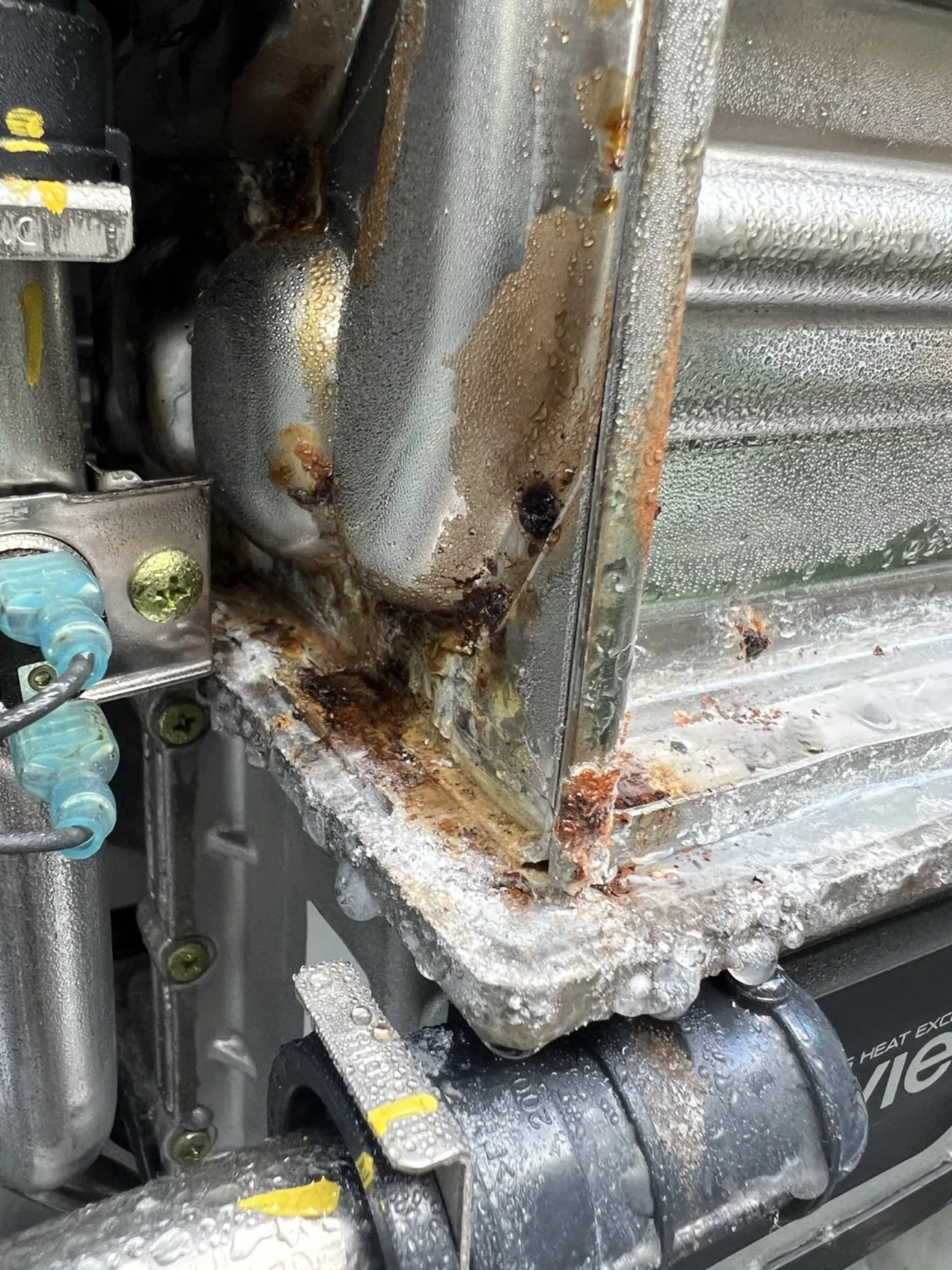
When that drain clogs, or a seam or vent joint lets moisture in, water sits where it was never meant to. The photo at the top of this page shows where that ends up: rust built along the base and seams of the heat exchanger. Damp windward air does an outdoor cabinet no favors either. We clear the condensate path, track down where the water came from, and tell you plainly how far the corrosion has gone.
When it clicks and never lights.
A heater that tries to fire, clicks a few times and then gives up is reporting an ignition or flame fault.
The common causes are a worn igniter, a flame sensor so coated it cannot tell the burner lit, gas pressure that sags when another appliance kicks on, and a vent or air intake that is partly blocked. We check gas pressure at the unit while it fires, clean or replace the sensor, and look over the vent run end to end. A fault that shows up only when the dryer and the range are going at the same time usually points to the gas supply, and the heater is just the first appliance to complain.
Whatever we find, it gets explained in plain words with a price attached before any part goes in, and that price is what you pay at the end.
Repair or replace, told to you straight.
Most tankless problems are repairable, and a flush or a new sensor can buy a unit years. The math changes with an older heater whose exchanger is badly corroded, a model the maker no longer supports with parts, or a unit that has needed a repair every few months. Paying for a sensor on a heat exchanger that is rusting through just moves the bill down the road.
Age by itself does not decide it. We read the serial plate for the manufacture date, look at how the exchanger and burner have held up, and ask how the unit has behaved over the past year. A clean ten-year-old heater can be worth another repair, while a five-year-old one that has sat in a flooded condensate trap may not be.
When we think replacement is the better spend, we explain why, show you the part, and give you both numbers so you can decide. If you go that way, our page on tankless installation for Kaneohe homes covers sizing and placement. And if a remodel is coming, plan the new heater together with the bathroom plumbing and any new shower valve, since each one affects how the others perform.
You can browse recent jobs, see what else we do in Kaneohe, or send us a note with the code from the display.
Frequently asked questions
Why does my shower go cold for a few seconds and then hot again?
Hot water left in the pipe comes out first, then the heater takes a moment to sense flow and fire, and cold water slips through in that gap. A short swing is normal. A long one, or a swing in the middle of a shower, points to low flow, scale, a dirty inlet screen or a sensor.
My heater is showing an error code. What should I do first?
Write the code down. Check that the breaker is on, the gas valve handle runs in line with the pipe, and the inlet screen is not packed with grit. If the code comes back, call us and read it to us. Leave the cabinet cover closed, since there is gas and live voltage inside.
How often should a tankless heater be flushed on Oahu?
We usually suggest once a year as a starting point, and sooner if hot water flow drops or the unit throws a scale code. Mineral content varies from house to house, so after the first flush we can tell you how much buildup came out and whether your schedule should change.
Is rust inside the cabinet a serious problem?
It depends on where it is and how far it has gone. Surface rust on a bracket is minor. Corrosion along the heat exchanger seams, usually from condensate that could not drain, is serious, because that part carries your water and the burner’s heat. We look closely and tell you which you have.
Can I flush the unit myself?
If isolation valves with flush ports are installed and you are comfortable with a small pump, hoses and descaler, plenty of owners do. Shut off the power and gas first and follow the manual for your model. If the valves are missing, have them added before anyone tries, so nothing gets cut or forced.
When is a tankless heater not worth repairing?
When the heat exchanger is corroded through or close to it, when parts for the model are no longer made, or when repairs keep stacking up on an older unit. In those cases we show you what we found and give you a repair price next to a replacement price, and the choice is yours.
Read us the code, or just describe it
Tell us what the heater is doing and what the display says, and we will call you back to arrange a visit. No hot water at all? Call (808) 445-3585 and talk to the crew directly.