
Filtration and a Tankless Heater on the Same Wall
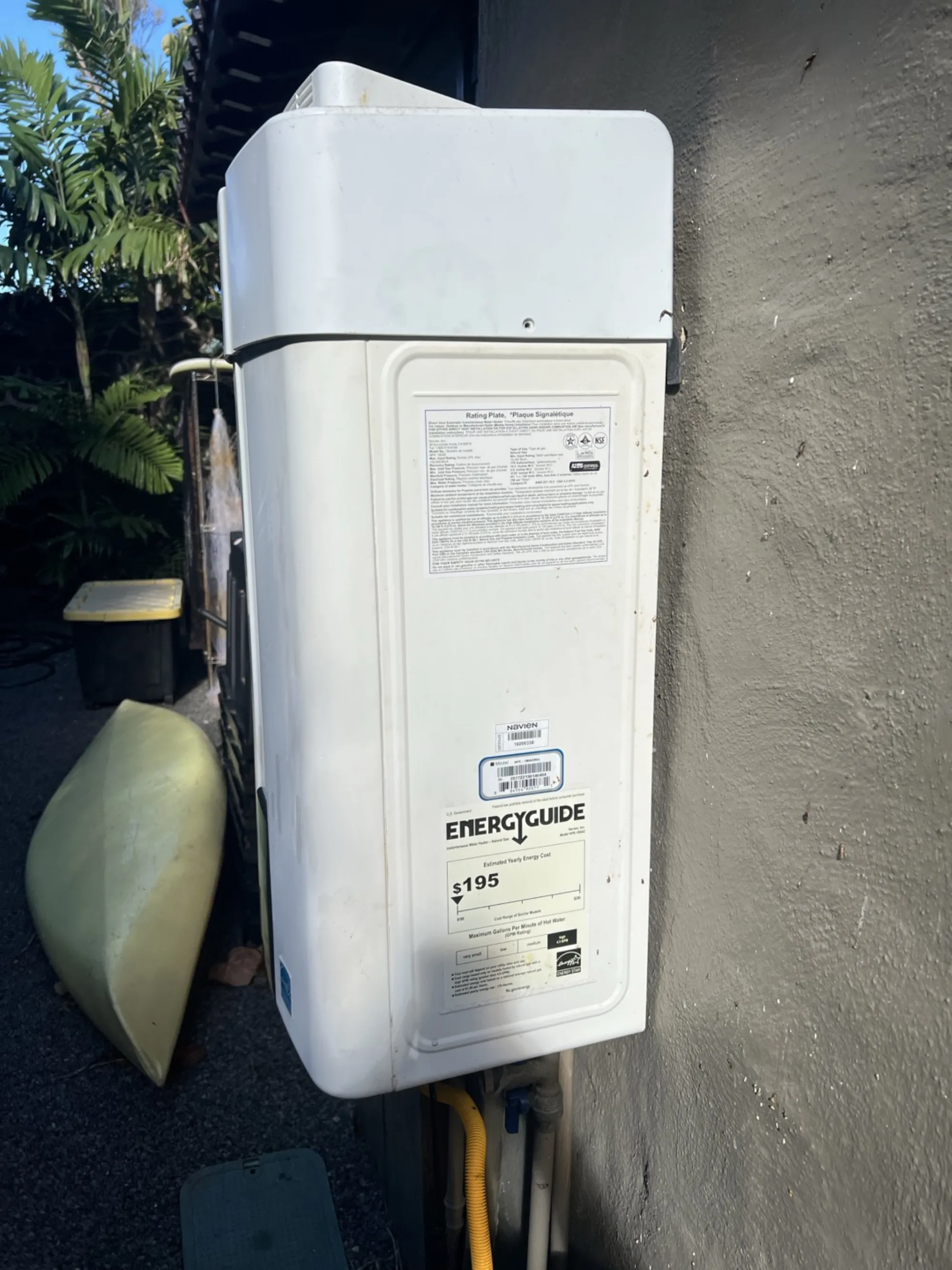
Filtration belongs upstream of a tankless heater, never after it. Put it in the wrong order and you send unfiltered water through the heat exchanger, then filter it on the way to the tap. The order is also a service question: two units on one wall need room to be worked on, not just room to hang.
Two things keep showing up on the same wall out here. A homeowner wants a tankless heater to stop running out of hot water, and the same homeowner wants filtration because of what the water does to kettles and shower glass. Often they get quoted separately, installed months apart, by different people who never talk.
Then we open the access panel two years later and find a heat exchanger full of scale, with a perfectly good filter housing sitting downstream of it doing nothing for the heater at all. The equipment is fine. The sequence was wrong.
Upstream or downstream, and why it is not a toss-up
Water comes into the house on one line, and everything after that point is downstream. A whole-house filter set placed right after the main protects everything behind it: the heater, the fixtures, the washing machine, the ice maker. A filter placed after the heater protects only what comes after the heater, which by then is the easy part.
Tankless heaters care about this more than tank heaters do. A tankless unit passes water through a narrow heat exchanger and heats it fast, and minerals come out of solution most readily exactly where water gets hottest fastest. Scale in those passages is the main reason a tankless unit loses output or starts short cycling. Feed it filtered, conditioned water and you have removed the thing that ages it.
There is one useful exception worth knowing. A drinking water unit under the kitchen sink is a point-of-use device and lives wherever that tap is, regardless of what happens at the main. Those two systems answer different questions, and having one does not remove the case for the other.
So the sequence on a wall reads: main, shutoff, filtration, then the heater, then the branches to the house. That is the order of the pipe, and once it is built that way it stays right permanently.
What the stack is actually for
People say “filter” as though it is one thing. It is usually two or three stages doing different jobs, and each stage is chosen for a problem you have rather than a problem a brochure has.
Sediment is the first stage almost every time. It catches grit and particulate, and its real job is to protect the stages behind it from clogging early. Carbon deals with taste, odor and chlorine, which is the stage people notice at the tap because it is the one you can taste. A conditioning or softening stage is the one that matters to the heater, because it is aimed at the minerals that leave deposits inside anything that gets hot.
Change intervals differ by stage, which is the part most homeowners are never told. Sediment cartridges load up fastest and get swapped most often. Carbon runs longer but quietly stops doing its job before it looks dirty, so it goes by calendar rather than appearance. Write the dates on the housings with a marker the day they go in, because a system nobody tracks becomes a system nobody services.
Where homeowners waste money is buying a big multi-stage system to solve a taste complaint, or buying a single carbon cartridge and expecting it to stop scale. Deciding what you want it to do first, then sizing the stack to that, is a fifteen-minute conversation that usually saves a purchase.
Sizing so the shower does not suffer
Every filter housing costs you some pressure. One good sediment cartridge costs very little. Three undersized housings in a row, each partly loaded, cost a noticeable amount, and the complaint that follows is never about the filters. It is “our shower got weak.”
That is why housing size gets matched to how many fixtures run at once, not just to the house square footage. A family that runs two showers and a washing machine in the same hour needs more flow capacity than a couple who never overlap. The tankless unit has its own flow appetite on top of that, since it needs enough water moving to fire at all.
Get those two numbers, household flow and heater demand, sitting in front of you before anything gets ordered. Matching them on paper is straightforward. Fixing a mismatch after the brackets are on the wall means buying a housing twice.
Leave room for the service you will actually do
Here is where good installs go quietly wrong. A tankless heater and a filter bank both fit neatly on a wall, and it is tempting to tuck them close together for a tidy look. Then cartridge change day arrives and there is no clearance to drop the sump, or the isolation valves for flushing the heater are pinned behind a housing.
Cartridge housings need vertical room below them to unscrew and lower. Tankless units need space at the service ports and enough room in front to open the cover. Both need shutoffs you can reach without a stool, because a filter change you dread is a filter change you skip, and a skipped cartridge becomes a pressure complaint six months later.
On an exterior wall install, common enough on Oahu, add one more consideration: the coastal air works on exposed hardware, and the brackets and fasteners holding all this weight should be chosen accordingly. We write the layout to be worked on, not just to look neat on day one. Our Ewa Beach water heater installation page goes deeper into sizing and venting, and the contact page is the fastest way to get us looking at your wall.

Questions about pairing the two
Do I need filtration to run a tankless heater?
You are not required to have it, but the heat exchanger is where deposits form first and worst. Conditioned water going in is the single biggest thing you can do to keep a tankless unit performing the way it did the week it went on the wall.
Will filters slow down my water pressure?
A properly sized housing costs very little flow. Undersized housings, or cartridges left in past their change interval, are what people feel in the shower. Size to how many fixtures run at once and change them on schedule.
Can both go on the same exterior wall?
Yes, and it is a common layout on Oahu. What matters is clearance: room under the housings to drop a sump, room at the heater’s service ports, and shutoffs you can reach standing on the ground.
Filtration first, heater second, service access planned before the brackets go up. Three decisions, made in an hour, that decide how both units behave for the next decade.
Putting both on one wall?
Tell us what your water does and how your household uses it, and we will lay out the order, the sizing and the access before anything is ordered.
More from the blog · Our Ewa Beach page · Ask about the wall stack